
Overview Importing Data Directory Tree File Management Processing Bird Detection Saving Data Synthetic Bird Song Download & Install ... Home
Bird Detection
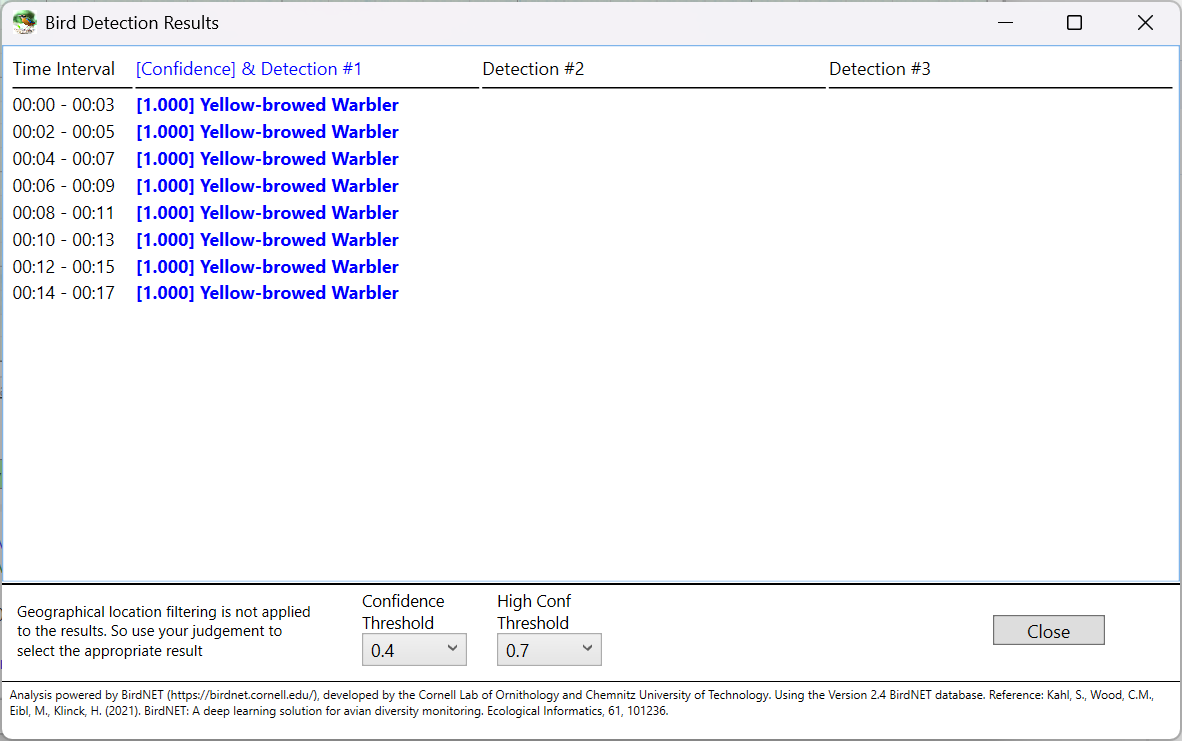
The BirdNET_GLOBAL_6K_V2.4(*1) model is included with the BirdWave App. To apply Bird Detection, first load and display a waveform and spectrogram of a bird song, then click the "Bird Detection" button on the lower right beneath the spectrogram display. A window of the results will pop-up.
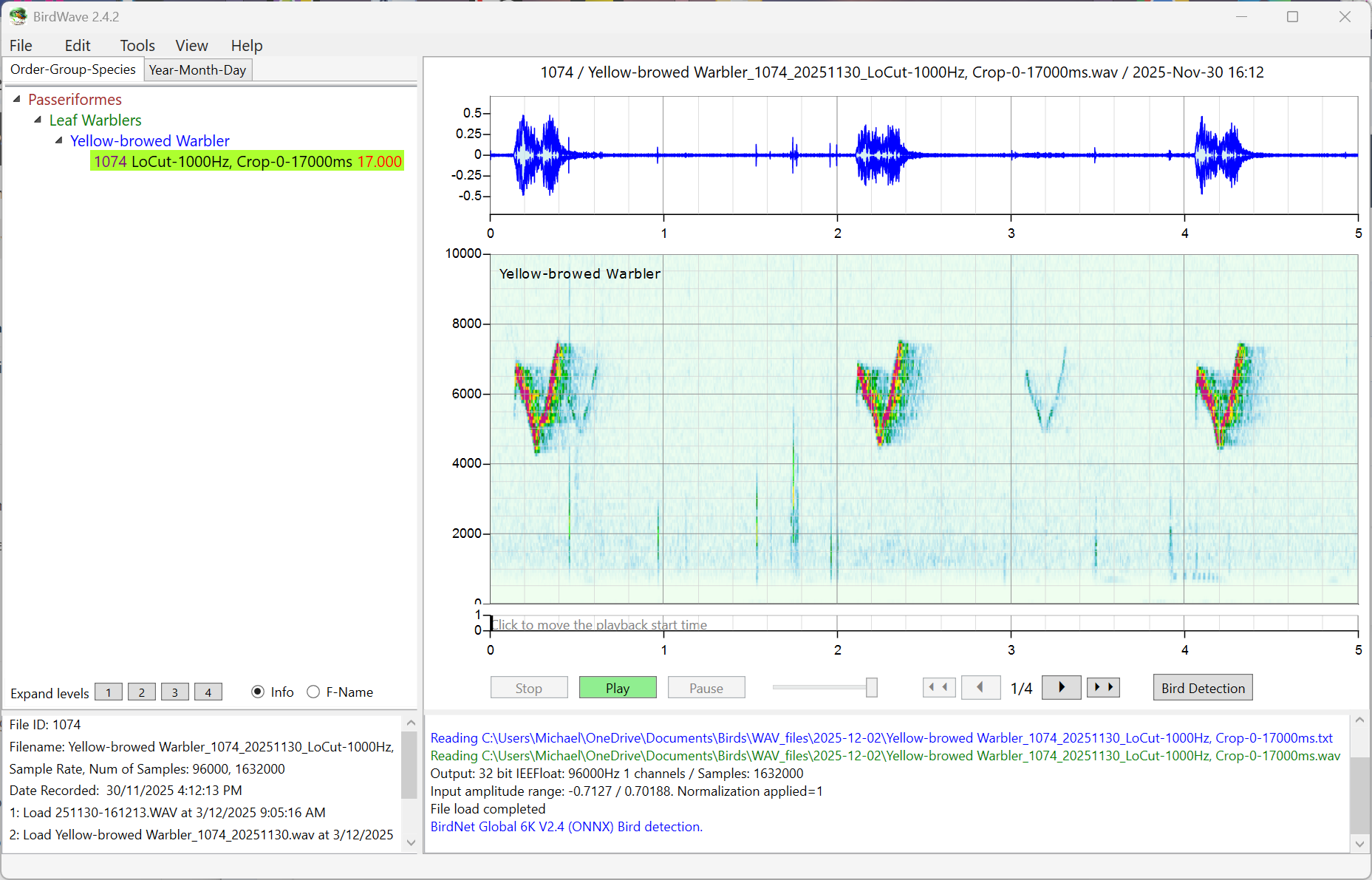
The Latitude and Longitude values are required to get the best results from Bird Detection, so it's recommended to set the Lat/Lon immediately after the data has been loaded. These can be set from Main Menu under "File -> Update Location Information"
The bird detection is done using 48 kHz sampled data over a series of 3 second windows. Each window is advanced 1.5 secs from the previous window to give a 1.5 second overlap. The results for each 3 second window are displayed, including a confidence rating and the interpreted bird species. By default only confidence values of > 0.4 are displayed. It is possible to change the confidence threshold using the drop-down list on the window.
If the waveform data is sampled at other frequencies, it will be internally re-sampled to 48 kHz before running the Bird Detection.
If the data is noisy, then the correct species may be identified with a low confidence values amongst other spurious results. With all results (including high confidence results), it is suggested to compare the recording with known recordings of the interpreted species, to confirm the result.
If Geographical filtering is not applied to results, then geographically un-realistic bird species may be seen in low-confidence results. You will need to use your local knowledge to ignore these and just focus on geographically realistic results. This is mostly an issue with low confidence results.
Recent Taxonomical Changes.
The bird species names in the BirdNET V2.4 model are not alligned with the most recent eBird taxonomy updates. For example, a recording of an Ornate Sunbird will return Olive-backed Sunbird, which is an obsolete name. To account for these descrepancies, a re-mapping table based on the species code, has been computed using archival eBird taxonomy lists to enable updating obsolete names. This re-mapping list contains 234 entries, which should account for most, but probably not all updates. So most obsolete names should be correctly updated, but a few may have slipped through and still show an older name
Reference
The BirdWave App uses the **BirdNET ONNX model** provided by the ONNX Community on Hugging Face (https://huggingface.co/onnx-community/BirdNET). The BirdNET model was originally developed by the BirdNET research team at the Cornell Lab of Ornithology and Chemnitz University of Technology. The ONNX export is licensed under the** MIT License**, which permits use, modification, and distribution (including commercial applications) provided that the copyright notice and license text are included. Copyright © BirdNET Team, ONNX Community.
(*1) - BirdNET (https://birdnet.cornell.edu/) was developed by the Cornell Lab of Ornithology and Chemnitz University of Technology. "Reference: Kahl, S., Wood, C.M., Eibl, M., Klinck, H. (2021). BirdNET: A deep learning solution for avian diversity monitoring. Ecological Informatics, 61, 101236.;